
Table of Contents
- What You'll Need Before You Start Organizing
- Step 1: Declutter and Purge Your Kitchen Cabinets
- Step 2: Categorize Your Kitchen Essentials by Zone
- Step 3: Maximize Vertical Space with Shelf Risers and Dividers
- Best Small Kitchen Cabinet Organizers Worth Buying
- Corner Cabinet Organization for Small Kitchens
- Under Sink Organization for Small Kitchens
- Kitchen Cabinet Organization Hacks You Haven't Tried Yet
Last Updated: July 30, 2026
Small kitchens punish disorganization more than any other room in the house. Knowing how to organize small kitchen cabinets is the single highest-use thing you can do to reclaim counter space, reduce meal-prep stress, and stop losing spatulas behind the soup cans. This guide from Johnny Kash & Carry Co. walks you through seven concrete steps, from the initial purge to a simple inventory system, so your cabinets work with your cooking habits instead of against them.
Here's what most guides get wrong: they jump straight to product recommendations before addressing the root problem. Buying more organizers for a cluttered cabinet just means a more organized version of the same chaos. The system has to come before the stuff.
What You'll Need Before You Start Organizing
Before pulling a single item off a shelf, gather your supplies. Starting without them means stopping mid-process, which is how half-organized kitchens stay that way for months.
Supplies checklist:
- Large trash bags (one for donations, one for trash)
- Sticky notes or masking tape for temporary labeling
- A permanent marker
- Measuring tape (cabinet depth and height matter when buying inserts)
- A cleaning cloth and all-purpose spray
- Shelf liner (optional but recommended for older cabinets)
Total Time: 2-4 hours for a standard small kitchen Difficulty: Beginner
Measure your cabinet interiors before buying anything. Cabinet depth in American kitchens typically runs between 12 and 24 inches. A shelf riser that fits a 24-inch cabinet will overhang in a 12-inch one, which creates a new problem rather than solving the old one.
Step 1: Declutter and Purge Your Kitchen Cabinets
The biggest mistake people make with kitchen cabinet organization is skipping the purge entirely. Three months later the cabinets are just as packed as before because the underlying volume of stuff never changed.
Pull everything out. Put it on the counter, the kitchen table, the floor. All of it.
The Keep, Donate, Toss Method
Kitchen cabinet organization becomes dramatically easier once you apply a three-pile system. The decision rule is simple:
Keep: Used at least once in the past 60 days, or genuinely seasonal. Donate: Functional but redundant. Two garlic presses. Three spatulas you never reach for. Toss: Expired pantry items, broken lids, single-use gadgets that never worked, mismatched containers without lids.
According to the National Association of Productivity and Organizing Professionals' guidance on decluttering, the average American home contains significantly more items than residents actively use, and kitchens are among the highest-density rooms for unused objects. The purge phase is where most of the real storage gain happens, not the product-buying phase.
Once you've sorted, wipe every shelf before anything goes back in.
Step 2: Categorize Your Kitchen Essentials by Zone
Most guides stop at "group like with like." Kitchen cabinet organization works best when categories map to your actual workflow, not to abstract tidiness principles.
The zone system for small kitchens:
| Zone | What Goes Here | Cabinet Location |
|---|---|---|
| Prep Zone | Cutting boards, mixing bowls, measuring tools | Near the counter or prep area |
| Cook Zone | Pots, pans, pan organizers, lids | Near or above the stove |
| Serve Zone | Plates, glasses, mugs | Near the dishwasher or sink |
| Store Zone | Pantry staples, canned goods, spice racks | Pantry cabinet or upper shelves |
| Utility Zone | Cleaning supplies, trash bags | Under-sink storage |
Heavy items belong at waist height. Lightweight, rarely used items go up high. Frequently used tools stay between shoulder and hip height.
Step 3: Maximize Vertical Space with Shelf Risers and Dividers
Vertical space is the most underused resource in any small kitchen cabinet. Most cabinets are 12 to 15 inches tall internally, but items stored in them are often only 4 to 6 inches tall. That gap above your plates or canned goods is dead storage.
Tiered Shelving and Stackable Bins
Shelf risers solve this immediately. A two-tier riser inside a cabinet effectively doubles the usable surface area of that shelf. Stackable bins work on the same principle: instead of reaching over a front row to find items in the back, you stack categories vertically.
Cabinet dividers are worth adding to any cabinet that holds baking sheets, cutting boards, or pot lids. Vertical storage of flat items is more space-efficient than horizontal stacking and eliminates the avalanche problem.
Cabinet Door Space and Adhesive Hooks
The inside of a cabinet door is functional real estate that most people ignore. Adhesive hooks rated for the weight of your items can hold measuring cups, pot lids, or small cutting boards without a single screw. For renters, this is especially useful because it requires no wall damage.
Best Small Kitchen Cabinet Organizers Worth Buying
Choosing the best small kitchen cabinet organizers comes down to matching the product to the specific constraint you're solving.
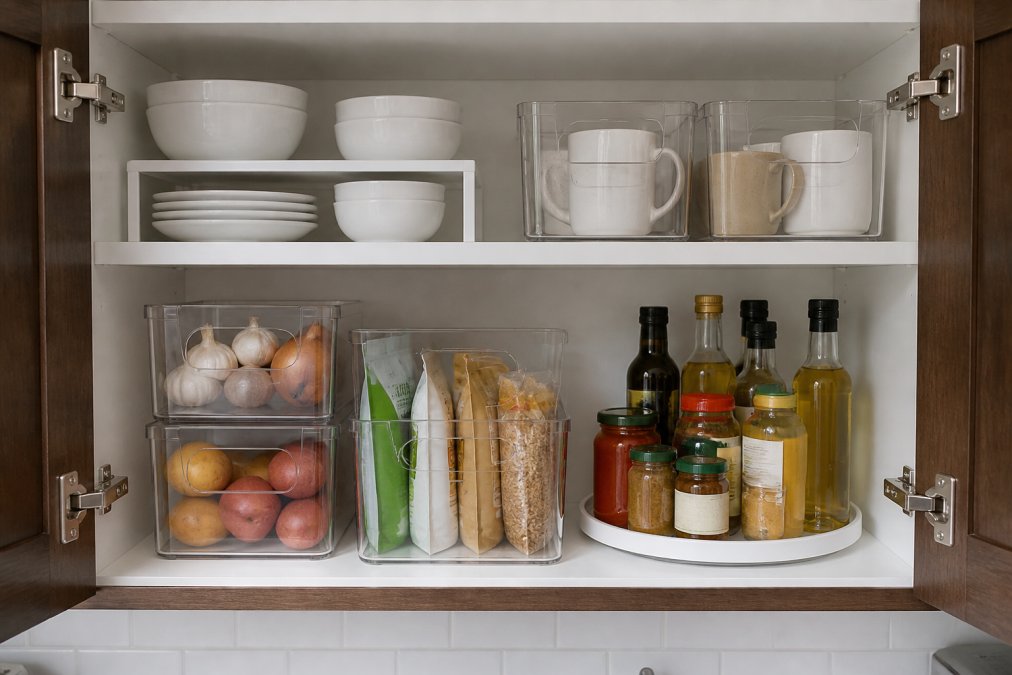
Pan Organizers, Lid Storage, and Lazy Susans
Pan organizers hold pots and pans vertically, which frees up the horizontal stacking space that typically consumes an entire lower cabinet. A lazy susan is the most effective tool for corner cabinet organization in a small kitchen, making every item reachable with a single spin.
Lid storage deserves its own solution. A dedicated lid organizer, either a rack that mounts inside a cabinet door or a standalone vertical holder, keeps lids accessible without clatter.
Drawer Organizers and Spice Racks
Drawer organizers are non-negotiable for utensil drawers. A basic bamboo or plastic divider set costs very little and pays back that investment within the first week.
For spice racks, the choice comes down to cabinet space versus counter space. Cabinet-mounted spice racks keep countertops clear. Countertop spice racks are more accessible but consume space that's already at a premium.
Johnny Kash & Carry Co. carries a range of trending kitchen organization gadgets, including space-saving stackable bins and tiered organizers, at up to 45% off. Every order ships with full tracking so you can see exactly when your new organization system arrives.
Corner Cabinet Organization for Small Kitchens
Corner cabinet organization for small kitchens is one of the most searched problems in home organization. The standard blind corner cabinet is genuinely awkward to use without the right hardware.
The lazy susan is the most practical solution for most people. Pull-out corner drawers, sometimes called "magic corner" systems, use a hinged shelf mechanism that slides out and rotates, bringing items from the back forward. These require installation but are significantly more accessible for people with mobility limitations.
For upper corner cabinets, stackable bins in two or three tiers at the front of the shelf keep the most-used items accessible. Reserve the back of upper corner cabinets for seasonal items you access a few times per year.
The better strategy is to accept that corner cabinets are unsuitable for frequently used items and assign them to items you use least often, while optimizing your accessible cabinets for daily-use essentials.
Under Sink Organization for Small Kitchens
Under-sink organization for small kitchens presents a specific challenge: the plumbing. The pipes under a kitchen sink create irregular shapes that standard rectangular bins can't fill efficiently.
Expandable under-sink shelves with adjustable legs can be configured to clear the P-trap and drain pipe while still providing a second storage level. Tension rods mounted horizontally inside an under-sink cabinet create a hanging storage system for spray bottles, which frees up the cabinet floor for bins and baskets.
What goes under the sink is worth being deliberate about. Cleaning supplies, trash bags, and dish soap belong here. What doesn't belong is anything sensitive to moisture or heat fluctuation.
According to the Environmental Protection Agency's guidance on household chemical storage, cleaning chemicals should be stored in their original containers, away from food items, and in areas with adequate ventilation. The under-sink cabinet meets those criteria for most households.
Kitchen Cabinet Organization Hacks You Haven't Tried Yet
The real gains come from addressing the constraints that standard guides ignore: rental restrictions, accessibility needs, and the slow creep of cabinet chaos over time.
Rental-Friendly Modifications That Won't Damage Walls
Renters face a real constraint that homeowners don't: anything that damages walls or cabinet interiors may cost you your security deposit. Most effective storage solutions are now available in damage-free versions.
Adhesive command strips and hooks have improved significantly. Tension-mounted organizers use spring pressure rather than screws. Freestanding shelf units sit on the cabinet floor without touching walls.
Accessibility and Ergonomic Storage Tips
Ergonomic storage is the angle that almost every kitchen organization guide ignores, and it matters most for long-term usability. A beautifully organized cabinet that requires you to crouch, stretch, or strain to access daily items is not actually well-organized.
The most frequently used items should be stored between hip and shoulder height, requiring no bending and no reaching above the shoulder. Items used weekly can go one level above or below that zone. Items used monthly or seasonally go to the extremes.
For people with limited mobility, pull-out drawers inside base cabinets are significantly more accessible than fixed shelves. The ADA National Network's guidance on accessible kitchen design provides detailed recommendations for kitchen layouts that accommodate users with a range of physical abilities.
A Simple Inventory Management System for Your Pantry
The reason kitchen cabinets get disorganized again within weeks of a big organization session is that there's no system for maintenance. The simplest version: a small whiteboard on the inside of a cabinet door listing what's in that cabinet. When you use the last of something, you write it on the shopping list.
A slightly more structured version uses a "first in, first out" rotation for canned goods and pantry staples. New items go to the back. Older items come to the front. This eliminates the expired-goods problem.
The real benefit of an inventory system is that it forces you to confront what you actually have before you buy more of it. Most overstuffed pantries contain duplicates purchased because the original was buried and invisible.
Knowing how to organize small kitchen cabinets is straightforward. The harder part is building habits that keep the system working. A five-minute weekly reset, putting things back in their zones and checking for items that have drifted, is more effective than a full reorganization every few months.
| Organization Problem | Best Solution | Difficulty |
|---|---|---|
| Wasted vertical space | Shelf risers, stackable bins | Easy |
| Cluttered corner cabinet | Lazy susan or pull-out corner system | Easy-Medium |
| Disorganized utensil drawer | Bamboo drawer dividers | Easy |
| Under-sink chaos | Adjustable shelving + tension rod for sprays | Easy |
| Cabinet door space unused | Adhesive or tension-mounted door organizers | Easy |
| Spice rack overflow | Tiered cabinet insert or door-mounted rack | Easy |
| Pantry items getting lost | FIFO rotation + label system | Easy |
Frequently Asked Questions
How do you organize a small kitchen with no pantry?
When there's no pantry, treat every cabinet as prime real estate. Use vertical space with shelf risers and stackable bins to double your storage capacity. Assign dedicated zones, one cabinet for dry goods, one for cookware, one for small appliances. Wall-mounted racks and adhesive hooks on cabinet doors free up interior shelf space. A simple inventory management system, like a running list on your phone, helps you avoid buying duplicates and keeps countertop space clear.
How do you organize pots and pans in a small kitchen cabinet?
Pan organizers and vertical cabinet dividers are your best tools here. Stand pans upright using a wire rack or tension rods inside a deep cabinet rather than stacking them flat, this saves significant space and makes grabbing one pan easy without disturbing the rest. Store matching lids in a dedicated lid storage rack mounted on the cabinet door or inside the cabinet beside the pans. A lazy susan in a corner cabinet also works well for round pots.
How do you organize a small corner kitchen cabinet?
Corner cabinet organization in a small kitchen works best with a lazy susan or a pull-out swing shelf insert. These allow you to access items stored at the back without digging. If a lazy susan isn't an option, use stackable bins or tiered shelving to keep items visible and reachable. Reserve corner cabinets for less-frequently used kitchen essentials like large mixing bowls, seasonal bakeware, or bulk pantry items so prime real estate stays accessible.
How do you organize under a small kitchen sink?
Under-sink storage in a small kitchen is tricky because of the plumbing. Use a two-tier expandable shelf that fits around the pipe to reclaim vertical space. Stackable bins or pull-out drawers keep cleaning supplies grouped and easy to grab. Adhesive hooks on the inside of the cabinet door hold spray bottles or small tools. Avoid storing food items under the sink due to moisture exposure. A tension rod across the cabinet is a budget-friendly DIY hack for hanging spray bottles.
What should not be stored in kitchen cabinets?
Avoid storing items that are heat-sensitive near the stove, including certain oils, spices, and chocolate, heat and steam degrade them faster. Medications, vitamins, and supplements are commonly kept in kitchen cabinets but do better in a cool, dry location away from humidity. Rarely used appliances that hog prime cabinet space should move to higher shelves or a storage closet. Keeping non-kitchen-essentials out of your cabinets is one of the easiest kitchen cabinet organization wins.
Getting your kitchen cabinets under control takes one focused afternoon and the right tools. If you're ready to act on this guide, Johnny Kash & Carry Co. carries the trending organization gadgets that are actually worth buying, at up to 45% off, with fast tracked shipping on every order and a secure checkout so your purchase arrives without stress. Browse the current selection and get your small kitchen working the way it should.
This article was written using GrandRanker