
Table of Contents
- Why Fake Reviews Matter to Your Shopping Decisions
- Red Flags: What Fake Reviews Actually Look Like
- Analyze Reviewer Profiles for Authenticity
- Examples of Fake Reviews and How to Recognize Them
- Best Review Checker Tools and Browser Extensions
- How to Report Fake Reviews on Google and Other Platforms
- FTC Guidelines on Online Reviews and Consumer Protection
- Conclusion
Last Updated: August 16, 2026
Why Fake Reviews Matter to Your Shopping Decisions
Fake reviews can derail your purchasing decisions entirely. A single inflated five-star review from a bot account might convince you that a product solves a problem it doesn't actually solve. Understanding how to spot fake online reviews protects your wallet and your time.
The scale of review manipulation has grown significantly. E-commerce platforms host millions of reviews daily, and not all come from genuine customers. Some reviews are written by competitors trying to tank a product's rating. Others are incentivized feedback from people paid to post positive comments, or generated entirely by AI systems designed to mimic human language convincingly.
At Johnny Kash & Carry Co., we understand that our customers need confidence in product reviews before making purchasing decisions. This guide walks you through specific techniques to identify fake reviews before they influence your buying choices.
Red Flags: What Fake Reviews Actually Look Like
Fake reviews share recognizable patterns. The most obvious red flags appear in the language itself, the timing of posts, and the structure of the feedback.
Identical Phrasing and Repetitive Language
Real customers describe their experiences using varied vocabulary and personal anecdotes. Fake reviews often recycle the same phrases because they're either written by the same person or generated by AI trained on a limited dataset.
Look for reviews that use identical opening sentences across multiple posts. "This product exceeded my expectations" appears dozens of times in fake review campaigns. AI-generated reviews sometimes repeat specific sentence structures like "[Product name] is perfect for [use case]. I've been using it for [timeframe] and couldn't be happier." Genuine reviews vary this structure naturally.
Pay attention to how reviewers describe features. Authentic customers mention specific details about how a product works in their actual space. Fake reviews stay generic: "Great quality," "Amazing product," "Highly satisfied."
Overly Enthusiastic or Vague Descriptions
Authentic reviews include both enthusiasm and specificity. A real customer might write: "This organizer actually fits under my kitchen sink, unlike the one I bought from another brand that was two inches too wide."
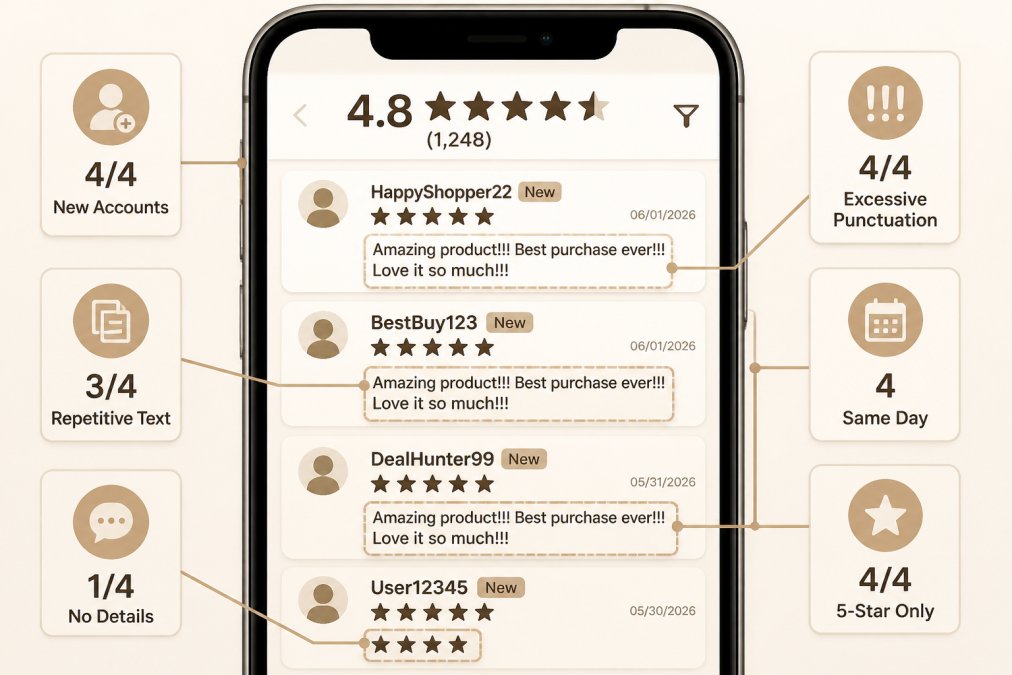
Fake reviews lean heavily into emotional language without substance. "This is absolutely amazing! Best purchase ever!" These reviews use excessive exclamation marks but never explain what makes the product good. Vague language like "it's just so good" or "everyone needs this" lacks the specific detail that comes from real experience.
Watch for reviews that praise a product for doing something obvious. "This cup holds liquid so well!" signals AI generation or someone copying product descriptions rather than describing actual use.
Suspicious Timing and Review Velocity
Real products accumulate reviews gradually as customers receive shipments and test products over time. Fake reviews often appear in clusters. If a product received five five-star reviews posted within two hours of each other from different accounts, that's suspicious activity.
Check the relationship between review dates and product availability. If a product launched three weeks ago but has fifty reviews from accounts claiming to have used it for months, the timeline doesn't add up.
Analyze Reviewer Profiles for Authenticity
Beyond the review text itself, the account posting the review tells you a lot. Fake review accounts often have telltale characteristics that distinguish them from genuine customer profiles.
Check Review History and Posting Patterns
A genuine reviewer builds a history over time. An account created yesterday with five reviews posted today is suspicious. Real customers accumulate reviews gradually as they make purchases.
Look at the products they've reviewed. If someone has posted reviews for fifty different products across wildly different categories in just two weeks, they're likely part of a review farm. Authentic customers typically review products they've actually purchased.
Examine the time between reviews. Legitimate customers post reviews sporadically as they buy and use products. Fake reviewers often maintain a steady posting schedule, one review every few hours, day after day.
Look for Scene-Setting and Product Knowledge
Real customers describe their actual experience using the product. They mention their specific situation: apartment size, family situation, how they use the item daily. A real review might say: "I live in a studio apartment with zero storage, so I was skeptical this would fit. It slides perfectly under my bed and holds twice what I expected."
Fake reviews skip this context. They might say "Great for storage" without explaining what they're storing or where they put it. Real reviewers also mention drawbacks or limitations. "It works great but it's heavier than I expected" shows honest assessment. Fake reviews rarely include any criticism.
Examples of Fake Reviews and How to Recognize Them
Example 1: The AI-Generated Review
"This product is absolutely fantastic! I purchased it two weeks ago and I have been extremely satisfied with my purchase. The quality is outstanding and it works exactly as described. I would highly recommend this to anyone looking for a product like this. Five stars!"
Red flags: Generic praise with no specific details. "Works exactly as described" is copying the product description, not describing actual use. Repetitive sentence structure. No mention of how the product fits into the reviewer's life.
Example 2: The Competitor Attack
"Terrible product. Broke after one day. Waste of money. Don't buy this garbage. Get [competitor brand] instead."
Red flags: Extreme negativity with zero specifics. No explanation of how it broke. Sudden shift to recommending a competitor by name.
Example 3: The Incentivized Review
"Just got this amazing gadget and I'm obsessed! Best purchase ever! My whole family loves it. Already ordered another one for my sister. Highly recommend!"
Red flags: Excessive enthusiasm without specific details. Claims of immediate satisfaction. Mentions ordering another one immediately, suggesting a paid reviewer trying to sound like a repeat customer.
Example 4: The Timing Cluster
Three five-star reviews posted within 47 minutes of each other:
- "Love it!" (posted 2:15 PM)
- "Perfect!" (posted 2:34 PM)
- "Couldn't be happier!" (posted 3:02 PM)
Red flags: Clustered posting within a short timeframe. Identical brevity and enthusiasm. No substance to any review.
Best Review Checker Tools and Browser Extensions
Several tools can help you identify suspicious review patterns more quickly. Browser extensions scan product pages automatically and highlight reviews showing signs of manipulation. They look for patterns like identical phrasing across multiple reviews, suspicious reviewer account creation dates, and unusual posting velocity.
Third-party review analysis platforms let you upload a product URL and receive a report on review authenticity. Some services specifically track reviewer profiles across multiple platforms to identify known review farm participants.
Use these tools as a starting point, then apply manual verification techniques. Automated tools aren't perfect and can't replace human judgment.
How to Report Fake Reviews on Google and Other Platforms
When you identify a fake review, reporting it helps protect other shoppers and improves the platform's review integrity. Most major e-commerce platforms have straightforward reporting mechanisms.
On Google Shopping and Google Reviews, look for a flag icon or "Report" button beneath each review. Amazon's reporting process is similar, find the "Report abuse" link under each review. On marketplace platforms like eBay or specialized retailers, look for a "Report this review" option in the review section.
When you report a review, include specific details about why you believe it's fake. "This review uses identical phrasing to five other reviews posted today" is more helpful than "This seems fake." If you notice a coordinated campaign of fake reviews, report multiple reviews together and mention the pattern.
FTC Guidelines on Online Reviews and Consumer Protection
The Federal Trade Commission provides clear guidance on what constitutes a legitimate online review and what counts as deceptive practice. According to FTC guidelines on endorsements and testimonials, any review that results from a financial arrangement must clearly disclose that relationship.
The FTC enforcement actions against fake reviews have targeted companies that post fake reviews or hire review farms to manipulate product ratings. These actions resulted in significant fines and required companies to stop the practice.
Consumers have rights under the FTC Act when they encounter fake reviews. You can file a complaint with the FTC Consumer Sentinel Network for reporting fraud if you believe a company is using deceptive review practices.
Conclusion
Spotting fake online reviews comes down to recognizing patterns: identical language, suspicious timing, vague descriptions, and reviewer accounts that don't match legitimate customer behavior. Real reviews contain specificity, honest drawbacks, and genuine scene-setting. Fake reviews rely on generic enthusiasm, formulaic language, and mechanical consistency.
When you shop at Johnny Kash & Carry Co., you're buying products backed by real customer feedback and transparent reviews. Our secure, encrypted checkout and tracked shipping mean you can confidently purchase trending gadgets and home essentials knowing your data is protected. Use these verification techniques, apply the tools available to you, and report suspicious reviews when you find them. Your diligence helps protect the entire online shopping community.
Frequently Asked Questions
What are the most obvious signs of a fake review?
The clearest red flags include identical phrasing across multiple reviews, overly enthusiastic language without specifics, reviews posted within hours of each other, and reviewers with no verified purchase history. Grammar mistakes, scene-setting descriptions that sound scripted, and reviews that mention unrelated products also signal fake feedback. Check the reviewer's profile history, if they only review one type of product or leave dozens of reviews daily, that's suspicious.
How do I report fake reviews on Google and Amazon?
On Google, click the three-dot menu next to a review and select 'Report review.' Choose the reason (fake review, spam, or offensive content) and submit. Amazon's process is similar: select 'Report abuse' under the review. Both platforms investigate flagged reviews and remove those violating their policies. Provide specific details about why you believe the review is fake, identical phrasing, unverified purchases, or suspicious timing, to strengthen your report.
Are there tools that can help me identify fake reviews automatically?
Yes, several browser extensions and third-party tools analyze reviews for bot activity, anomalous patterns, and sentiment inconsistencies. These tools scan for red flags like unnatural distribution of ratings, sudden surges in feedback, and AI-generated language patterns. While no tool is 100% accurate, they're useful for quickly flagging suspicious reviews before you make a purchase decision. Always combine automated tools with manual review analysis for the best results.
What does the FTC say about fake and incentivized reviews?
The FTC requires that endorsements and testimonials be honest and represent the reviewer's genuine experience. Incentivized feedback must be clearly disclosed, reviewers can't accept payment for positive reviews without revealing it. The FTC also prohibits fake reviews, bot activity, and undisclosed affiliate relationships. Businesses violating these guidelines face penalties. As a consumer, understanding these FTC guidelines helps you identify when reviews may have been manipulated or paid for without proper disclosure.
The most important thing you can do right now is apply these techniques to your next online purchase. Before you buy, spend two minutes checking reviewer profiles and scanning for the red flags outlined here. You'll quickly develop an instinct for spotting manipulation, and you'll make smarter purchasing decisions as a result.
This article was written using GrandRanker